
Inspiration is nothing with Application
Engage, Align, Enrol your people to Lead Change
Cascading Leadership
At times of great stress or political turmoil, ‘strongman’ autocratic leaders will always move to the fore, as their superficial presentation of action and decisiveness begin to look more attractive than the quiet, collaborative, thoughtful approaches of other types of leadership. Despite this, even a cursory glance at World History reveals those modelling #OpenLeadership have the more enduring impact and are more effective, long term. Dictators operate on a bang or bust timeline.
You’ve probably guessed the above is a perhaps prescient and certainly appropriate introduction to this repost of “Cascading Leadership”. Whilst updated to be relevant for the opening weeks of 2026, it has an evergreen value, as one of my Three Core Insight philosophies alongside (also recently updated) “Be Ready for Open Leadership” and “Still Leading From Purpose”.
I hope that you will find this updated piece timely, beneficial, and stimulating in considering your own leadership skills and character. If you’d like expert help with this, please talk to me.
Cascading Leadership
We all know the model of the charismatic leader (e.g., Steve Jobs) who has a powerful vision and, almost messianically, can both engage and align everyone in their organisation around it. Almost inexplicably, everyone moves powerfully in the same direction and quickly aligns around how to achieve it.
Yet this type of “top-down” leadership is increasingly shown to be too simplistic and often far less effective than it may once have been. It also lacks the long-term stability and success of other models.
So, what method can you use instead that has shown to be more effective and enduring?
The starting point for Cascading Leadership is simple: to slow down.
I love and encourage the adage “slow down to speed up later”. Relationships are still one of the most powerful tools for business (and life!), and trust takes time to build, so my advice is to slow down and take time. Once trust is deeply held, the speed of decision and action is faster.
The problem is that, in the world we live in today, time is money. Speed is important. I am very often approached by CEOs and other senior leaders who are ready, hungry even, to lead brave change in their organisation. They often have a clear idea as to their vision and are desperate to launch it fast, and desperate for next steps, imploring me against a background of mounting pressures:
“How can I best engage people around my vision for change?”
My first action is always to position the value of “slow down to speed up later” and ask for their trust around that. It is key to have them understand and trust that this approach will work. With that boundary set, trust between us can continue to build (like the whole process of Cascading Leadership itself).
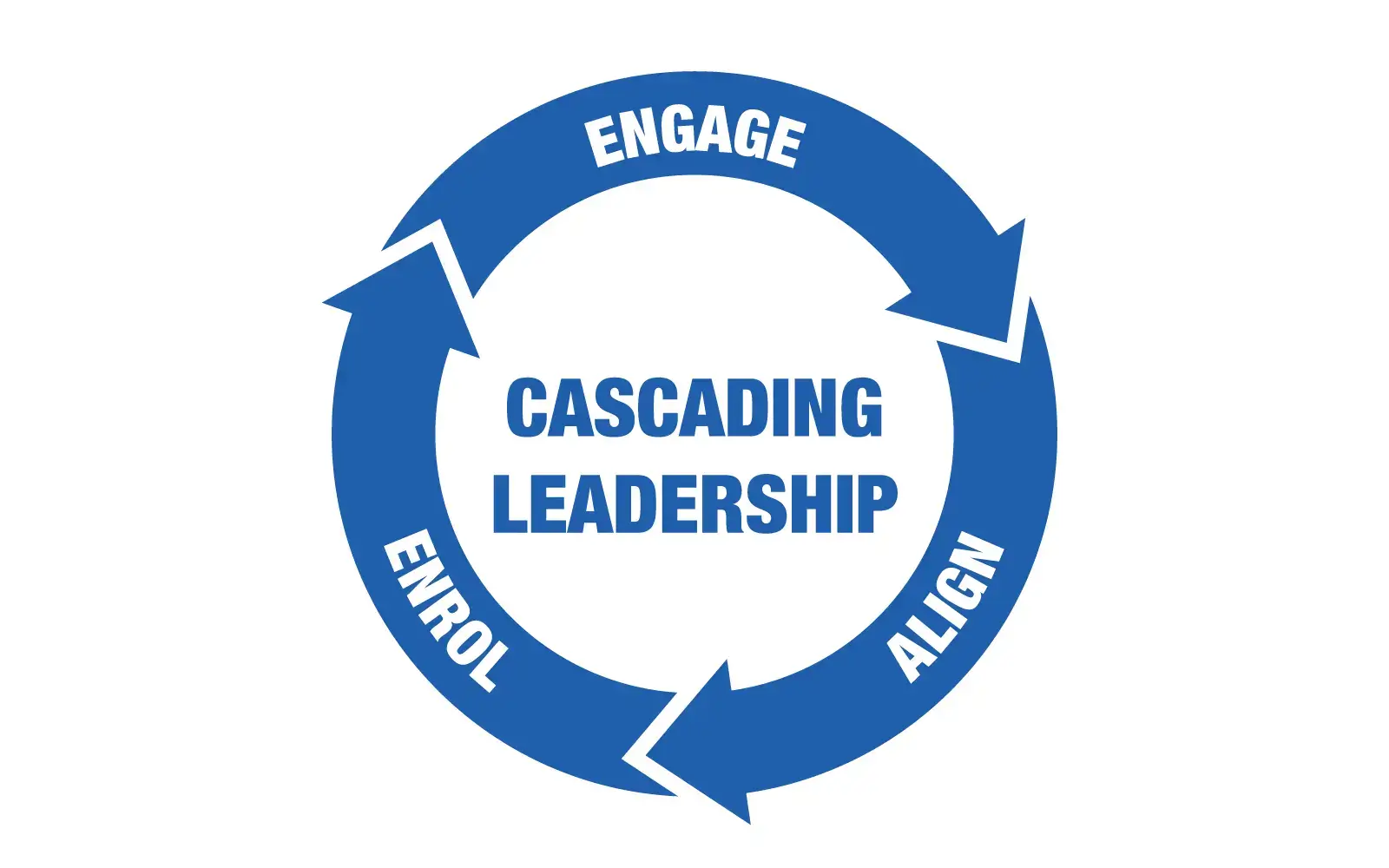
The Virtuous Circle
Having gained some mutual breathing space, and not rushed towards immediate action, it is appropriate to consider if one should first look to Engage people around a vision for change, or instead to Align people around it.
Let me challenge the orthodoxy of looking to Engage people around change as a first step, and instead suggest there should be no “what to do first” but a virtuous circle of engage, align, engage, align repetitively. Each iteration in the cycle mutually deepens both elements while also building more and more internal trust in the overall organisation, as people feel truly part of the vision.
Pebbles and Ripples
Now, back to the process. Having gained some trust from the leader and their permission to slow down, the first step is to polish the pebble.
The pebble?
The pebble is the initial vision. The first step is to work 1:1 with the leader to refine their vision in a way in which they can engage the first tier of influencers in their organisation, typically their leadership team, their “first line reports”.
At this stage, it is key that the leader a) distils their vision to only two or three words, and b) is open to it being shifted and changed with input from this first tier. This focus and openness (remember Open Leadership?) will then engage them to work with the leader to refine the vision.
In short, we polish the pebble first before sharing with anyone else.
The first ripple
The second step is then to bring the leader and their ‘first tier’ leadership team together (often for a two or three-day offsite meeting) to refine the vision. The leader will seek to engage them around the idea on a basic level and, by all being part of the iterative process, they can then refine it and align around the revised vision, deepening their feeling of engagement. At this point, releasing that pebble has created the first ripple with the leadership team, achieved through slowing down and taking the time to engage them then work with them to align around the refined next iteration.
It is key to note that the initial vision will change as more and more people are involved. The leader must be open to input while remaining the “Keeper of the Vision” (remember Leading From Purpose?) for all, being mindful of any defensiveness their own ego may carry around their initial idea.
From a tiny pebble to cascading ripples
From that first ripple, the process is repeated throughout the organisation in ever-expanding circles. The specifics on how to do this vary for every organisation depending on size, structure, culture and other factors. However, the core elements of Cascading Leadership remain consistent, being:
- Anchor “slow down to speed up”, as there are no shortcuts here. The ROI of a deeply engaged and aligned organisation is immense and worth pursuing patiently.
- There is no “which comes first, Engage or Align” in this method; cascading is iteratively building both.
- Cascade outwards, take the time to create ever-expanding ripples from that first pebble.
- At each “ripple” stage, share the Vision to Engage, then give true space for input into the iterative process, while also asking members of each expanded circle what this means to them and how they feel they can best help the organisation achieve the vision.
As you can see, by slowing down to speed up, by iteratively engaging, aligning, engaging, aligning, this is a method where everyone in the organisation can be trusted to add their value to the vision and how it will be achieved. The ever-expanding ripples grow in strength and external impact, while consolidating internal trust and focus – all from that first pebble from the leader and subsequent careful Cascading Leadership.
How might this work in your organisation? Every organisation is different, every iteration of the cycle will vary. If you are ready to discuss your vision and learn how I can support you to achieve it, talk to me.